

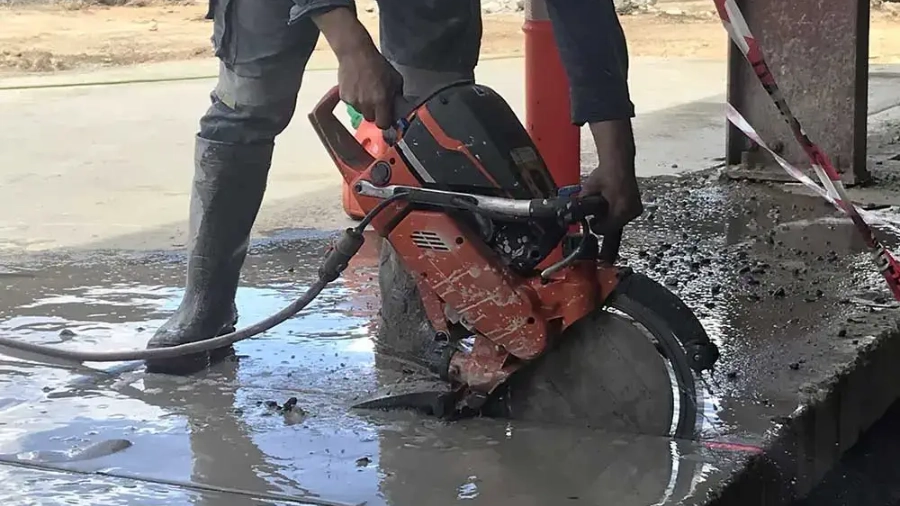
Professional contractors use wet cutting concrete and dry cutting concrete techniques for specific applications. The former is appropriate for slicing thick or reinforced concrete, while the latter is suitable for shallow cuts and areas with little water access. Depending on the project requirements, each method has unique advantages and disadvantages that compel technicians to select the proper approach.
This blog will delve deeper into the advantages and disadvantages of wet cut concrete and dry concrete cutting to provide clients with knowledge on the appropriate technique for their project requirements.
Key Takeaways
- Explanation of what “wet cutting & dry cutting” means.
- Advantages and Disadvantages of wet cutting.
- Advantages and Disadvantages of dry cutting.
- Guidance on when to choose wet cutting vs dry cutting depending on project needs.
What Is Wet Cutting?
This technique uses wet saw concrete cutting equipment with water-cooled diamond blades. The apparatus sprays water directly on the concrete surface to prevent blade warping and operates at high revolutions per minute (RPM), allowing it to cut longer. Wet cutting saws can either be diesel- or gasoline-operated and work best on the following applications:
- Thick or reinforced concrete
- Projects in open or outdoor areas
- Applications that require accurate, clean cuts
- Projects prioritising dust reduction
Wet Cutting Advantages
The advantages of wet cutting include the following:
- Precision: Manufacturers design these blades for precise, accurate cuts on thick, reinforced concrete and resilient, sensitive materials.
- Speed: Wet cutting finishes projects faster than its dry counterpart, For instance, the former can finish sidewalk or driveway cutting in one to two days and accomplish slab or floor cutting in two to five days.
- Cost-effective: Users aren’t required to replace wet cutting blades frequently, so clients save more money over time.
- Safety: Water usage significantly reduces dust and prevents respiratory health issues. This water-based cutting technique also minimises overheating-related safety hazards.
- Noise reduction: Wet cutting produces less noise and vibrations than dry cutting, minimising disruptions and annoyances for surrounding neighbourhoods.
Wet Cutting Disadvantages
The disadvantages of wet cutting include the following:
- Water supply reliance: Wet cutting in areas with sparse water can be challenging. This inconvenience can delay project timelines and completions.
- Shorter lifespan: Although wet cutting blades are more cost-effective, they have a shorter lifespan than dry cutting. Regular care can extend blade life, as outlined in our concrete saw maintenance guide.
- Messy: Water sprays can combine with adjacent substances, such as dust, creating messy concrete sludges. Contractors must clean them to eliminate potential safety hazards.
- Electrical hazard: Water can create hazards with electrical equipment. As trusted Brisbane hand & ring sawing experts with over two decades of valuable industry experience, we strongly recommend installing water-susceptible machinery in the work area before proceeding.
What Is Dry Cutting?
Dry cutting uses a specific, heat-resistant blade to slice through concrete and other surfaces. Technicians use low-horsepower handheld saws for smaller projects.
Dry cutting equipment relies on surrounding air to cool down the blades. Hence, it free spins between cuts to maximise airflow and preserve the cutting mechanism. Some contractors use dry-cutting saws with a dust extractor or vacuum to prevent the dust from spreading to the work area.
Dry cutting is appropriate for the following applications:
- Indoor cutting and renovations
- Small-scale cutting projects
- Concrete block, brick, or paver cutting
- Cold or Water-restricted areas
- Asphalt and soft concrete cutting
Dry Cutting Advantages
The advantages of dry cutting include the following:
- Straightforward use: Since dry cutting equipment has more limitations than wet versions, the former creates shallow, straight cuts for small-scale projects.
- Portability: Many dry-cutting saws don’t require power sources, allowing technicians to use them freely and easily.
- Clean surroundings: Dry-cutting saws don’t spray water and create concrete sludge, helping streamline project operations and preventing cleaning-related delays.
- Resiliency: Dry-cutting blades’ resilient and heat-resistant features help withstand friction and wear and tear and prevent warping or cracking. Their long lifespans allow them to complete numerous, diverse projects.
Dry Cutting Disadvantages
The disadvantages of dry cutting include the following:
- Dust: Dry cutting produces dust, which can cause respiratory health issues. As experienced Australian concrete cutting experts, we encourage the use of dust vacuums and dust extractors to enhance safety and minimise this possibility.
- Limited orientation: Dry-cutting blades cannot produce curved, circular, or angular cuts, significantly limiting their capabilities in landscaping or decorative concrete applications.
- Possible delays: Since this technique can only perform straight-line cuts, contractors may need additional tools, such as wet saws, angle grinders, or jigsaws, to complete the project. Unfortunately, more tools may result in significant delays or disruptions.
- Prolonged operation: Dry cutting takes longer than wet techniques and requires more downtime.
FAQs
What is the main difference between wet cutting and dry cutting concrete?
Wet cutting uses water-cooled diamond blades to cut through concrete while controlling heat and dust. Water sprays directly onto the cutting area, which helps the blade stay cool and reduces airborne dust. Dry cutting uses heat-resistant blades and relies on airflow to cool the blade between cuts. It does not use water, so it avoids slurry and works better in areas where water access is limited. Wet cutting is usually better for thick, reinforced, or more precise work, while dry cutting suits shallow cuts, small projects, and indoor applications.
When should wet cutting be used for concrete?
Wet cutting is generally used for thick concrete, reinforced concrete, outdoor projects, and jobs that require clean, accurate cuts. Because the blade is cooled by water, it can cut for longer and work more efficiently on tougher materials. It also helps reduce dust, which can support safer working conditions. Wet cutting can be suitable for driveways, footpaths, slabs, floors, and other projects where precision, speed, and dust control matter. However, it requires a reliable water supply and proper clean-up because the water can mix with dust and create concrete slurry.
When is dry cutting a better option?
Dry cutting is often better for small-scale cutting jobs, indoor renovations, shallow straight cuts, and projects where water access is limited. It is commonly used for concrete blocks, bricks, pavers, asphalt, and softer concrete. Dry-cutting saws are often portable and easier to use in tight or restricted areas because they do not need a water supply. They also avoid wet slurry, which can make the work area easier to manage. However, dry cutting produces more dust and usually takes longer than wet cutting, so dust extraction and proper safety measures are important.
What are the disadvantages of wet cutting concrete?
Wet cutting can be highly effective, but it does have some drawbacks. It relies on a consistent water supply, which can cause delays if the site has limited access to water. The water used during cutting can also mix with concrete dust and create slurry, which needs to be cleaned up properly to prevent safety hazards. There may also be electrical risks when water is used near equipment that is sensitive to moisture. While wet cutting can reduce dust and noise, the site still needs careful preparation and management before work begins.
What are the disadvantages of dry cutting concrete?
Dry cutting produces more dust than wet cutting, which can create respiratory health risks without proper dust control. Contractors often use vacuums or dust extractors to help manage this issue. Dry cutting is also more limited because it usually works best for straight cuts rather than curved, circular, or angled work. In some projects, additional tools may be needed to complete the job, which can add time and cause delays. Since dry cutting takes longer and requires downtime for blade cooling, it may not be the best choice for larger or more demanding concrete cutting work.
Conclusion
When deciding on the best concrete cutting method for residential or commercial projects, it’s crucial to consider numerous factors, such as precision, speed, safety, cost-effectiveness, and efficiency. This knowledge will empower clients to make enlightened decisions for their specific requirements.
Blade handling is one of the most glaring differences between the two methods. Technicians can use handheld dry-cutting saws for small-scale projects. On the other hand, wet cutting requires consistent, smooth handling to prevent chipping or binding. Reliance on water makes this method challenging in areas with sparse water supplies, limiting its potential and efficiency.
As Brisbane floor and road sawing experts with over two decades of experience, we strongly recommend considering your project’s scope, magnitude, and demands before choosing your preferred cutting technique.