

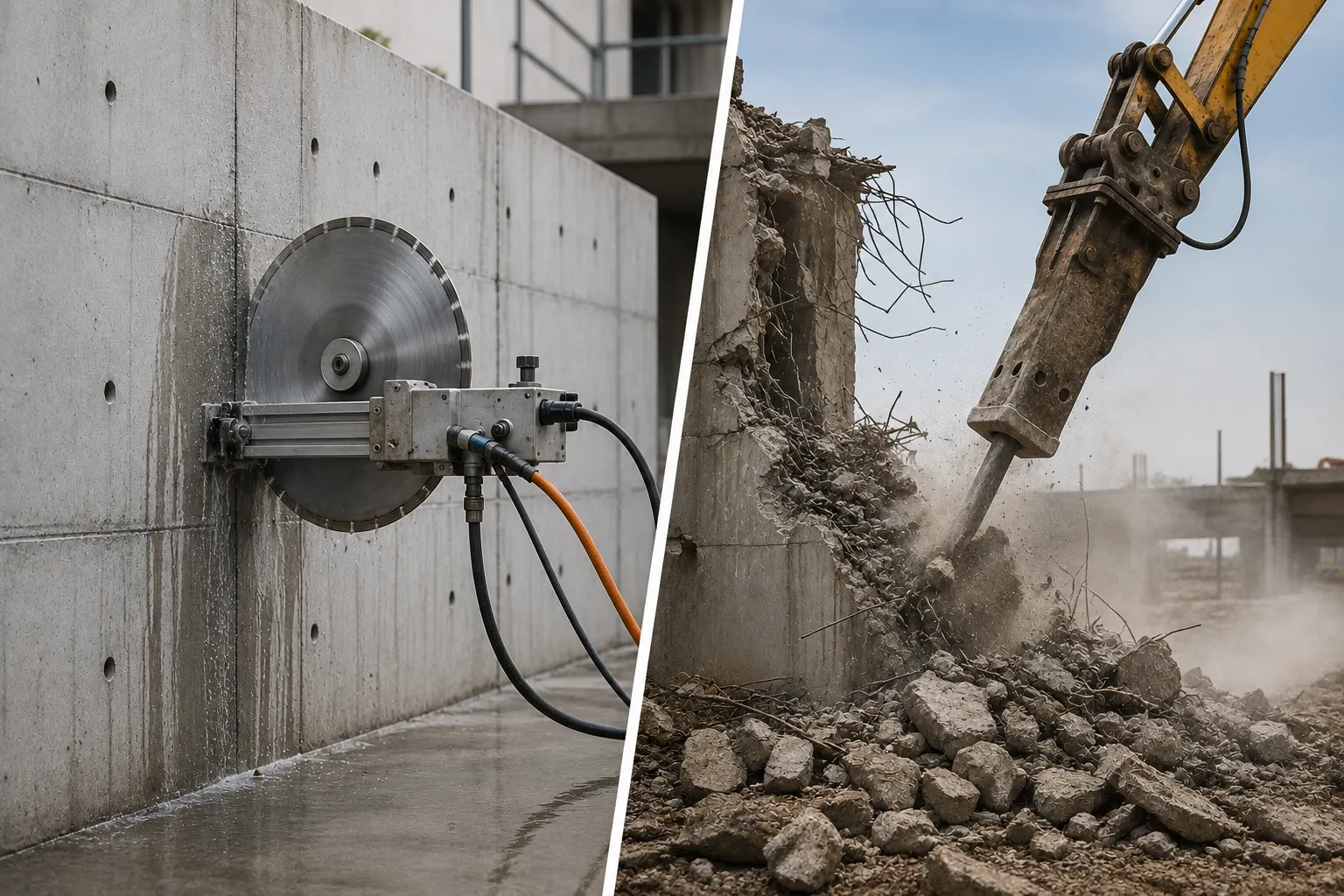
Conventional commercial structure demolition often involves heavy machinery, noise, dust, and heaps of rubble. The speed and efficiency of hydraulic breakers, bulldozers, and demolition excavators deliver a high return on investment and smoother project timelines.
Nowadays, clients in Australia can choose diamond cutting, a specialised construction technique that uses diamond-embedded blades, drill bits, and wire systems to cut, drill, or remove concrete with uncanny precision. As a reputable diamond cutting service provider serving numerous clients in Australia since 2003, our Brisbane core drilling services produce perfectly round holes for your plumbing, electrical, and HVAC applications. Learn more about why diamond blades cut concrete so effectively in our deeper dive on the topic.
Key Takeaways
- Traditional demolition uses heavy machinery and impact force to quickly break down concrete structures, making it ideal for large-scale removals where speed and cost-efficiency are priorities.
- Diamond cutting uses diamond-tipped blades, drills, and wire saws to create precise, controlled cuts with minimal vibration, noise, and dust.
- Projects requiring structural preservation, renovations, utility installations, or work in occupied buildings benefit most from diamond cutting due to its accuracy and safety.
- Traditional demolition is better suited to complete site clearances, major redevelopments, road removals, and projects where surrounding structures do not need protection.
- Common diamond cutting applications include core drilling for plumbing, electrical, and HVAC services, and road sawing for utility installations, pavement repairs, and expansion joints.
While both traditional demolition and diamond cutting have their unique advantages, choosing the appropriate technique can be a game-changer for your project. This blog explores when each method makes sense, helping you make informed decisions and enjoy seamless project timelines.
Key Differences Between the Two Methods
Understanding the key differences between traditional demolition and diamond cutting enables clients to determine the appropriate method for their project and achieve optimal, long-term outcomes. The right technique depends on your project’s goals, the structure’s condition, and the level of precision required.
These differences include:
- Method of removal: Traditional demolition uses impact force to break concrete into smaller pieces. Heavy machinery, such as excavators fitted with hydraulic breakers or jackhammers, repeatedly strike the concrete structure until it breaks and collapses.
On the other hand, diamond cutting uses diamond-embedded blades, drill bits, or wire saws to manipulate concrete structures. Instead of striking or smashing the material, this method creates clean, controlled, and precise cuts to deliver the intended results. Choosing the right blade matters too — see our guide on selecting the best diamond blade.
- Precision: Traditional demolition is less precise than diamond cutting. For this reason, it’s appropriate for projects requiring quick removal of entire sections or structures.
Conversely, diamond cutting offers exceptional precision and accuracy. As a reputable provider of Brisbane road sawing services since 2003, our operators remove only the required section of concrete and ensure the surrounding structure remains intact. We recommend diamond cutting for renovations, structural modifications, and utility installations.
- Vibration and structural impact: Traditional demolition’s impact force and heavy machinery produce significant vibration, potentially compromising adjacent concrete, finishes, and nearby structures.
Since diamond cutting produces minimal vibration, it significantly reduces the risk of cracking concrete or compromising structural integrity. This technique is suitable for clients whose objective is preserving the existing structure.
- Noise and dust: Traditional demolition’s heavy machinery and impact force produce considerable noise, dust, and debris. For this reason, project managers must enforce stringent additional dust suppression measures to protect workers’ health and safety.
In contrast, diamond cutting is significantly quieter than traditional demolition. Many contractors implement efficient wet-cutting techniques to cool the blade, prevent overheating, and suppress dust, resulting in a cleaner and safer work environment.
- Suitability for reinforced concrete: Although both techniques can be used on reinforced concrete, diamond cutting is more effective because it creates accurate cuts through both concrete and embedded steel reinforcement without excessive pressure.
- Speed: Traditional demolition’s ability to break down entire structures in less time makes it suitable for large-scale projects where speed matters more than precision.
Although diamond cutting may take longer for complicated demolition work, it saves time by reducing the need for repairs, clean-ups, and costly rework.
When Traditional Demolition Is The Better Choice
While diamond cutting offers exceptional precision, it is not the appropriate solution for every project. Traditional demolition continues to play a critical role in many projects in Australia, particularly those that prioritise speed, efficiency, and cost.
Heavy machinery, such as excavators equipped with hydraulic breakers, can demolish massive concrete structures far more quickly than diamond cutting equipment. For this reason, the former is a more practical and economical solution for large-scale demolition projects.
Traditional demolition is also ideal for projects where preserving the surrounding concrete or adjacent structures is not a priority. These projects include those requiring comprehensive redevelopment or sites that must be cleared entirely before new construction begins.
Projects requiring extensive road removal, industrial site clearances, or large concrete slab demolition can benefit more from conventional demolition methods. Since they prioritise removing large quantities of material rather than making accurate openings or structural modifications, impact-based demolition is more appropriate than diamond cutting.
When Diamond Cutting Delivers Greater Value
Although concrete diamond cutting has a higher upfront cost than traditional demolition, its accuracy, safety, and emphasis on structural integrity provide better long-term value. Project managers prioritising the preservation of existing concrete will benefit greatly from diamond cutting’s accurate technology.
This innovative method is valuable in occupied buildings, such as offices, hospitals, shopping centres, and flats, where minimal disruption and noise are essential. Road saws, wire saws, wall saws, and ring saws produce minimal noise and vibration, making them ideal for these structures. Experienced diamond cutting professionals also use wet-cutting techniques to suppress dust, contributing to a safer, healthier worksite.
Diamond cutting is the safer option when working around ageing, sensitive structures or concealed elements. Diamond-tipped blades, core drills, or wire saws can also safely navigate reinforced concrete with post-tensioned cables or embedded utilities, preventing costly damage and preserving long-term structural integrity.
Diamond cutting’s ability to produce clean, straight edges that require minimal additional finishing also appeals to many clients. This innovation facilitates seamless project timelines, simplifies the installation of new building components, and reduces overall labour costs.
Ultimately, diamond cutting delivers greater value than traditional demolition when precision, safety, and structural preservation are the main priorities.
Common Applications for Concrete Diamond Cutting
Understanding two common applications for concrete diamond cutting enables you to make informed decisions for your project and experience smooth timelines.
These in-demand concrete diamond cutting applications include:
- Core drilling: This type of concrete diamond cutting creates perfectly round openings through concrete walls, floors, and ceilings. These holes are mainly used for plumbing pipes, electrical conduits, telecommunications cables, and HVAC systems.
Diamond core drills create accurate holes with minimal vibration and little risk of compromising the adjacent structures, making them valuable tools for occupied buildings, renovations, and reinforced concrete applications.
- Road sawing: Also known as slab sawing or floor sawing, road sawing is a common technique used for infrastructure and civil construction projects. Large diamond-tipped blades slice concrete and asphalt when installing underground utilities, repairing road surfaces, creating expansion joints, or removing damaged pavement sections,
Road sawing’s straight, precise cuts help preserve the surrounding pavement, preventing costly repairs and facilitating seamless project timelines.
Conclusion
There is no one-size-fits-all solution to concrete removal. Traditional demolition is the conventional choice for projects that require fast turnaround times and large-scale material removal.
On the other hand, we recommend concrete diamond cutting for projects in Australia prioritising precision, safety, and structural integrity. Understanding the unique advantages of each method enables you to select the strategy that produces the intended optimal outcomes and delivers long-term peace of mind.
Whether you require cost-effective robotic demolition or concrete diamond cutting services, Cutrite’s expertise, proven track record, and steadfast commitment to 100% customer satisfaction and safety make us a trusted partner for various projects across Australia. Book an appointment today to discuss your needs and discover how our innovative solutions can support your project.