

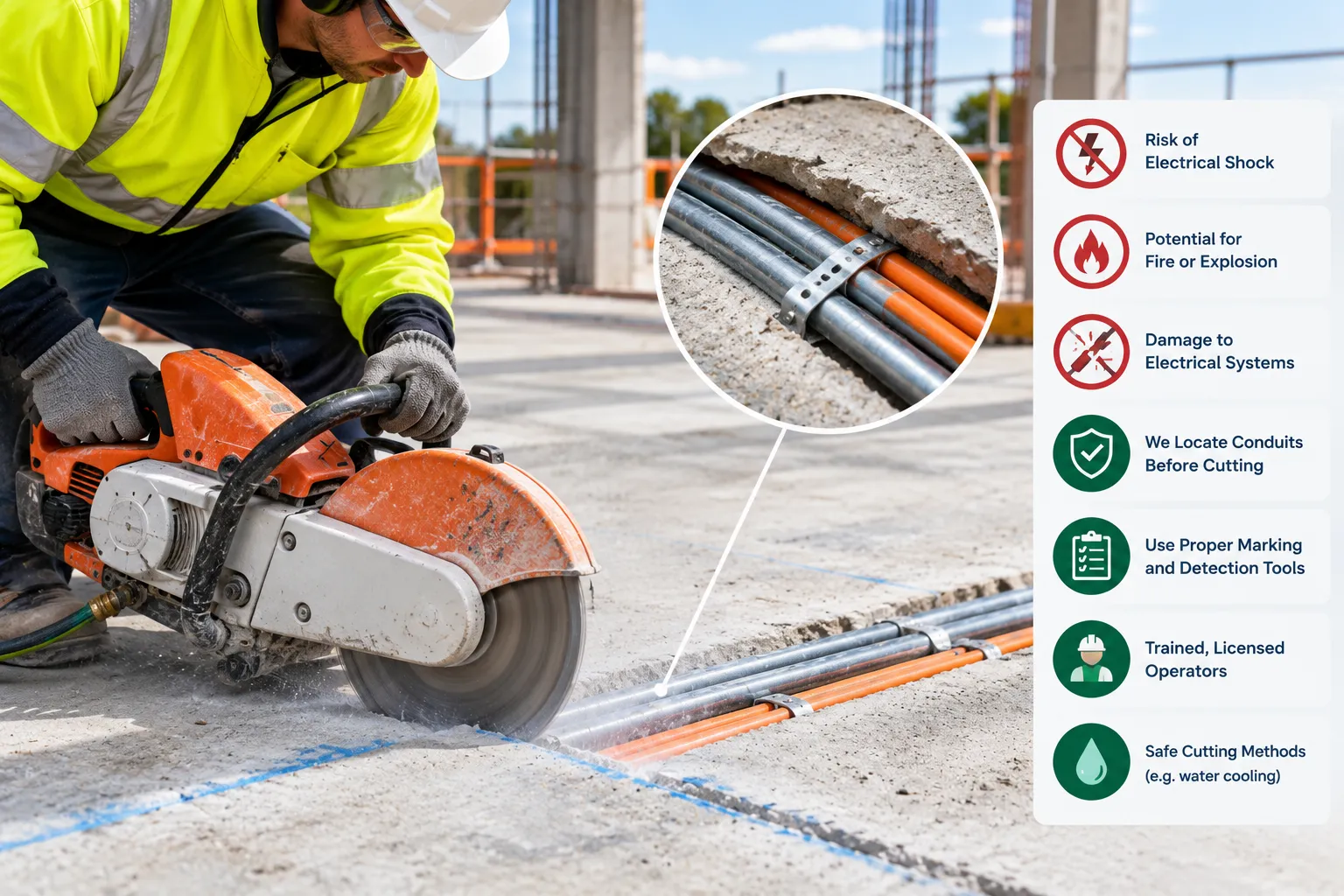
Concrete conceals steel rebar, post-tension, telecommunications cables, plumbing pipes, gas lines, metal fixtures, and redundant infrastructure. Many commercial buildings in Australia also hide electrical conduits (the plastic or metal tubing that protects the wiring running through walls, floors, and slabs), which, when cut haphazardly, can become a costly hazard that can injure workers and significantly delay your project timeline. As a trusted provider of Brisbane core drilling services, we encourage you to take proactive steps to prevent these scenarios and gain long-term peace of mind.
If you’re planning to hire a commercial concrete cutting company for renovation, fit-out, or structural work, understanding the critical importance of conduit identification eliminates a potential safety hazard and facilitates a seamless project. This blog explains the risks of cutting near electrical conduits and several preventive measures you and a highly experienced contractor can take to identify concealed services, prevent accidental damage, protect workers and building occupants, and keep your project on track.
Key Takeaweays
- Cutting near electrical conduits can create serious safety risks, particularly if hidden electrical services are accidentally struck during concrete cutting.
- Electrical conduits may be concealed within concrete, making it difficult to identify their exact location without appropriate detection equipment.
- Service locating and concrete scanning should be completed before cutting, helping identify embedded conduits and determine safer cutting locations.
- Accidental damage can cause electrical hazards, equipment damage and costly repairs, while also creating potential risks for workers and surrounding occupants.
- Professional planning and controlled cutting methods reduce these risks, helping ensure electrical services are identified and protected before work begins.
Why Conduits Are Often Overlooked
Unlike a pipe running along the surface of a wall, electrical conduits are usually buried deep within the concrete or embedded behind wall linings, following paths that don’t always align with outdated building plans.
Renovations, retrofits, and previous trade work often add new circuits that were never properly documented. Over the life of a commercial building, plans can become outdated or go missing altogether, which means relying on drawings alone can make electrical conduit detection challenging.
It’s important to remember that a conduit that looks abandoned or unused on paper might still be live. Without direct on-site verification, there’s no reliable way to know which conduits are carrying current and which aren’t just by looking at a floor plan.
The Consequences of Striking an Electrical Conduit
Striking a live electrical conduit with a saw, drill, or core bit can cause an electric shock or arc flash strong enough to seriously injure or kill workers or building occupants. Even when nobody is hurt, the damage to a building’s electrical circuits can knock out power to parts of the building. Sometimes, this power cut affects systems well beyond the immediate work area, including fire alarms, security systems, or equipment frequently used by tenants and occupants.
This isn’t a small or rare risk category in Australian construction. According to Before You Dig Australia (BYDA), more than 15,000 underground and embedded service strikes occur across the country every year, affecting telecommunications, water, gas, and electricity infrastructure, despite over 2.7 million plan requests being lodged through the same service annually. That gap between service check frequencies and actual strike occurrences shows why checking plans alone is never enough. On-site detection before cutting closes that gap, improves on-site safety, and significantly enhances project efficiency.
Identifying Electrical Conduits Before Cutting
As a responsible provider of Brisbane road sawing services, we never rely on guesswork or outdated drawings alone. Before any cutting or drilling starts, we scan the area using innovative tools, such as ground-penetrating radar (GPR) and cable locators, which can detect both the physical location of conduits and, in many cases, whether a line is carrying live current.
Whether the property owner provides an old or a new building plan, we always prioritise safety and take preemptive measures to identify concealed electrical conduits before cutting. It’s important to note that some building plans can be outdated, irrelevant, or obsolete. For this reason, plans should be treated as a useful reference instead of the sole source of information when locating concealed services.
Where a scan identifies a conduit in the path of planned work, the next step is confirming with the building’s electrical contractor or facilities manager whether that circuit can be isolated before cutting work begins. Isolating power to the relevant area, even temporarily, removes the shock risk entirely and lets the crew proceed with confidence and eliminate potential safety threats.
Clear on-site communication matters just as much as the equipment used. Cutting locations are marked out, areas with identified services are flagged, and the crew is briefed before tools are switched on. Combined with cutting-edge tools and careful site assessment, effective communication significantly reduces the risk of damage to electrical conduits during concrete cutting.
Factors to Consider When Hiring a Concrete Cutting Company
When choosing a contractor for work in an occupied or older commercial building, ask directly how they identify electrical conduits before cutting. Enquire whether scanning is a standard practice or something you need to request separately. A company that treats this as routine, rather than optional, prioritises safety and is worth adding to your shortlist.
We also recommend considering a contractor that offers extensive concrete cutting services aligned with your project requirements. These services include:
- Core drilling services for precise openings around service-dense areas.
- Wall drilling services for penetrations through internal and external walls.
- Road sawing services for larger external concrete work.
Regardless of your project’s scope and duration, a reputable concrete cutting company with the proper scanning equipment, assessment expertise, and extensive range of services can identify dangerous electrical conduits, eliminate risky guesswork, and deliver a high return on investment and peace of mind.
At Cutrite, we always prioritise worker and tenant safety. We can identify your building’s electrical systems with our innovative equipment and thorough on-site assessment, enabling us to cut through openings, internal and external walls, and larger concrete work without risk. Book an appointment today to discuss your vision and bring your project to life.
Frequently Asked Questions (FAQs)
How can you determine if an electrical conduit is live before cutting?
Scanning alone can’t always confirm if an electrical conduit is live. We work with the building’s electrical contractor to isolate any conduit found in the cutting path, where possible. This step removes the shock risk before the tool ever touches the surface.
Can you trust building plans alone to identify concealed electrical systems?
It’s critical to note that building plans can become outdated over time, especially when renovations and past trade work often become undocumented. On-site scanning is used alongside plans to identify hidden electrical conduits before cutting starts.
What equipment can detect electrical conduits hidden in concrete?
Ground-penetrating radar (GPR) and dedicated cable locators are the standard tools. Together, they help identify both the physical location of embedded conduits and, in many cases, whether a line is currently carrying electrical current.
Can scanning significantly prolong a project?
Scanning usually adds only a few hours to a project. Given the safety risk and potential cost of striking a live conduit, this critical step is a small trade-off against a much more serious and expensive outcome.
What are the consequences of striking a conduit?
Work stops immediately, power is isolated, and a licensed electrician assesses the damage before anything continues. Any injuries are treated as a priority, and the incident is documented for the building owner.
Source: Before You Dig Australia (BYDA), “Australia’s Underground Utility Safety Reckoning”