

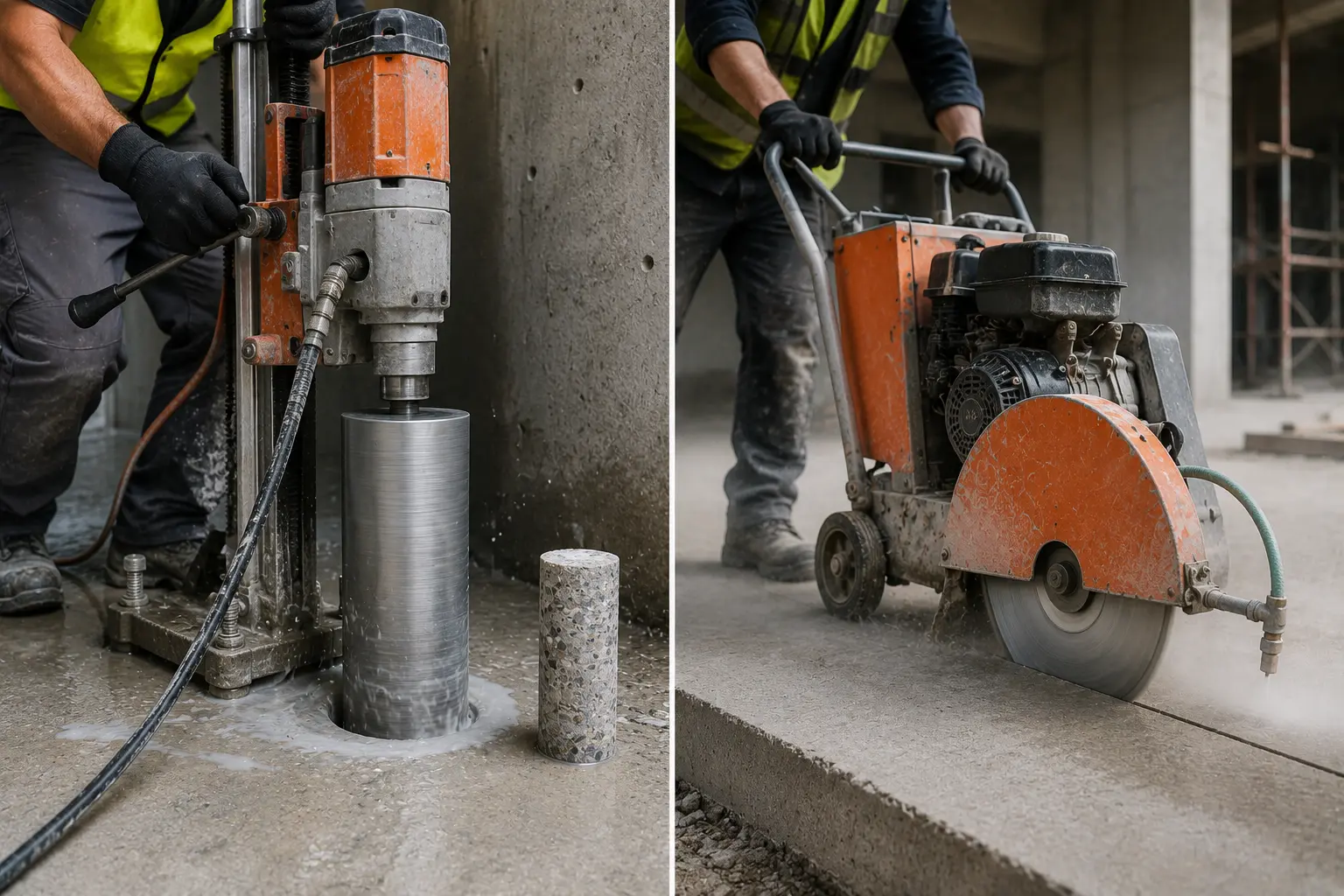
Whether managing a residential, industrial, or commercial construction project, knowing the key differences between core drilling and concrete cutting enables you to choose the most suitable method for your specific requirements, improve efficiency, minimise delays, and ensure optimal results throughout every stage.
Concrete, a mixture of cement, water, and aggregates, is the primary material in most construction projects in Australia. Its strength, durability, and versatility make it ideal for many structures, such as bridges, sidewalks, skyscrapers, and airport runways.
Since modern post-concrete settling methods are complex, Brisbane hand and ring sawing experts must use the appropriate drilling or cutting technique to preserve long-term structural integrity and prevent costly damage. Regardless of the method, always confirm the concrete has cured sufficiently first — our guide on how long after pouring concrete covers the recommended waiting times.
Key Takeaways
- Core drilling creates precise circular holes in concrete using diamond-tipped drill bits, making it ideal for pipes, cabling, and HVAC systems.
- Concrete cutting uses specialised saws to make straight cuts for demolition, trenching, door openings, and slab removal.
- Core drilling offers low vibration, reduced noise, and accurate openings, but it is slower and limited to circular cuts.
- Concrete cutting is faster and highly versatile for large-scale projects, though it is less effective for smooth circular openings.
- Choosing between the two depends on project requirements, access limitations, structural needs, and the desired final result.
As a Brisbane floor sawing contractor serving numerous clients in Southeast Queensland for nearly 25 years, we offer valuable insights to ensure a smooth project timeline. This blog explores the key differences between core drilling and concrete cutting, empowering you to take charge of your project and enjoy long-term peace of mind.
Core Drilling Defined
Core drilling creates accurate circular holes in concrete, masonry, or asphalt using a diamond-tipped drill bit. It’s the broader technical term that is used interchangeably in the construction industry with concrete coring, which emphasises the material being drilled (concrete) and the removal of the cylindrical core.
The two types of core drilling include:
- Soft coring: This core drilling technique uses nested barrels to create circular holes of up to 150 metres. The inner barrel pushes through the material to obtain the sample, while the outer barrel prevents the hole from collapsing.
- Hard coring: Similar to soft coring, hard coring uses nested barrels. However, the outside barrel extends first, allowing air or drilling fluid to wash and preserve the material.
Typical core drilling applications include:
- Plumbing pipes.
- Electrical conduits and cabling.
- HVAC ducts and vents.
- Fire protection systems.
- Obtaining concrete samples for structural testing.
Core Drilling Pros
The pros of core drilling include:
- Precise circular openings: Diamond-tipped drill blades create smooth, accurate holes that preserve long-term structural integrity.
- Low vibration: Modern core drilling methods’ reduced vibration features ensure minimal damage, making them suitable for retrofits in occupied structures and sensitive settings, such as hospitals, schools, and churches.
- Minimal noise output: Wet coring systems produce significantly less noise than saw cutting or jackhammer techniques, enabling projects to comply with local noise regulations.
- Dust control: Wet coring methods have efficient water cooling systems that capture dust, protecting respiratory function and overall site safety.
Core Drilling Cons
The cons of core drilling include:
- Depth limitations: Core drills can usually reach depths of up to 150 metres. Projects requiring deeper applications must have large-diameter rigs, which can significantly increase costs and extend project timelines.
- Time efficiency: Core drilling can take significant time in projects requiring significant structural removal. As trusted providers of Brisbane core drilling services since 2003, we recommend wall sawing or flat saw cutting for larger applications instead. For a detailed breakdown of typical timelines, see our guide on how long core drilling takes.
- Limited applications: Concrete coring can only create circular holes, making it unsuitable for projects requiring square- or irregularly-shaped applications.
Concrete Cutting Defined
Concrete cutting requires specialised saws with diamond blades to make straight, controlled cuts through concrete surfaces or structures.
The three types of concrete cutting include:
- Slab sawing: Slab sawing (flat sawing) removes the topmost layer of rough concrete to smoothen and level it. Track precision saws can remove small to large concrete slabs, making them suitable for airport runways, parking lots, and plumbing work.
- Wall sawing: Skilled and experienced technicians create accurate cuts through vertical and horizontal concrete slabs, such as bay doors, window openings, and ventilation.
- Wire sawing: Contractors often use wire sawing techniques in applications that traditional saw cutting cannot access, such as slicing heavily reinforced concrete, irregular-shaped structures, and areas with challenging space constraints.
The typical applications of concrete cutting include:
- Cutting expansion joints.
- Removing damaged concrete sections.
- Creating door or window openings.
- Demolishing or renovating commercial, industrial, and residential structures.
- Trenching for utilities.
Concrete Cutting Pros
The pros of concrete cutting include:
- Fast execution: Sharp diamond blades and wall saws can slice thick concrete slabs in seconds. For instance, floor saws can operate at speeds of up to 8 metres per minute under favourable conditions, saving time and facilitating faster project timelines.
- Versatile: Slab, wire, and wall sawing cover various residential, industrial, and commercial applications, including airport runways, parking lots, plumbing work, bay doors, and window openings. Their versatility provides project managers and clients with long-term peace of mind.
- Reduced vibration and noise: Concrete saws with diamond-tipped blades and water cooling systems significantly reduce vibration and noise, making them suitable for sensitive, quiet environments, such as hospitals, schools, laboratories, and churches.
Concrete Cutting Cons
The cons of concrete cutting include:
- Inaccurate cylindrical opening cuts: Concrete saws are not suitable for cylindrical openings. Although they can cut through these applications with several linear cuts, the final outcome isn’t as smooth as core drilling.
- Accessibility and blade size limitations: Wall saws and floor saws cannot operate properly in tight or overhead spaces. Operators must use hand or ring saws instead, as their compact designs allow them to work efficiently in confined areas inaccessible to larger cutting equipment. :
Conclusion
Core drilling and concrete cutting each serve distinct, unique purposes. Choosing the right method depends on your project’s requirements, scope, and desired outcome. Understanding their strengths and limitations enables you to make informed decisions that enhance efficiency, prevent costly delays and structural damage, and ensure smooth project timelines. Hiring an experienced core drilling or concrete cutting specialist guarantees safe, optimal, long-term results.
Whether your construction project requires reliable core drilling or concrete cutting services, Cutrite is ready to deliver safe, precise, and efficient solutions tailored to your specific requirements. Book an appointment today to arrange an on-site inspection and discover transformative core drilling and concrete cutting solutions.