

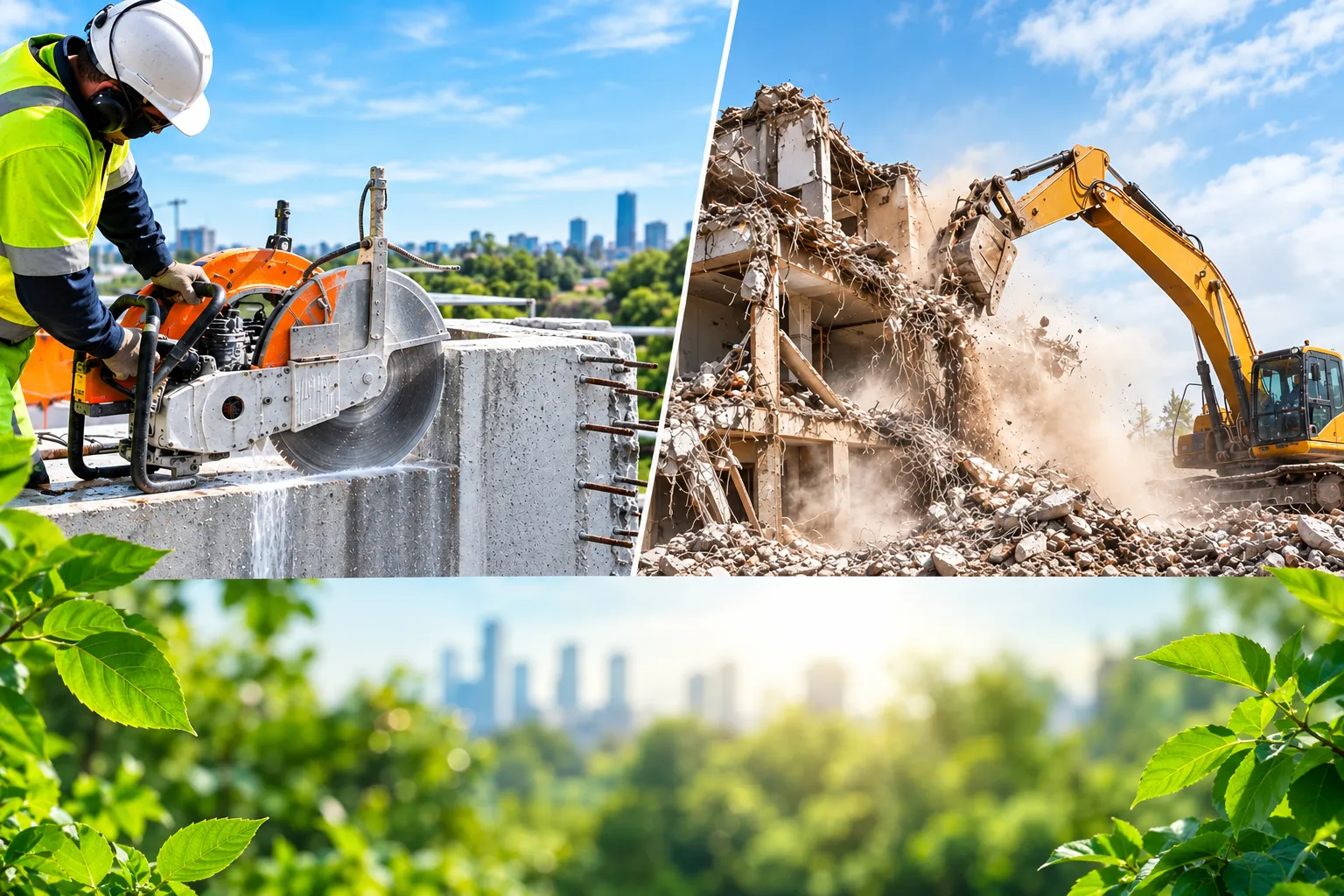
When a commercial building needs major structural modifications, the traditional approach is demolition with an excavator. It’s fast, loud, and leaves behind mixed rubble. Many projects in Australia now require a cleaner, safer way to do the job. Precise concrete cutting removes only what needs to go, with far less harm to the environment, making it an attractive option for clients seeking sustainable solutions for their projects.
If you’re planning a refurbishment, an extension, or a partial removal, we can help. This blog explains the environmental benefits of cutting over traditional knockdown demolition, helping you make informed decisions for your project and contribute to a greener planet.
Key Takeaways
- Concrete cutting supports selective demolition, allowing specific sections of a structure to be removed without demolishing the entire building.
- It can reduce construction waste, preserving reusable concrete and other materials while limiting the volume sent to landfill.
- Controlled cutting minimises disruption, helping reduce unnecessary damage to surrounding structures and materials during renovation or redevelopment.
- Reusing existing structures and materials can conserve resources, reducing demand for new construction materials and the environmental impacts associated with their production.
- Less destructive demolition methods can improve site efficiency, supporting more sustainable construction practices when combined with responsible waste sorting, recycling and material recovery.
The Scale of the Waste Problem
Building and demolition work is one of Australia’s biggest sources of waste. According to a summary of the National Waste Report 2022, Australia produced 75.8 million tonnes of waste in 2020–21, and 29 million tonnes of that came from construction and demolition. Once ash from power generation is set aside, the sector accounts for 45 per cent of the country’s core waste.
Every tonne has to be trucked, sorted, crushed, or buried. Choosing a method that creates less waste is the simplest environmental win available on a job site.
Less Waste, and Cleaner Waste
Knockdown demolition doesn’t discriminate. Concrete, steel, timber, plasterboard, glass, and wiring all come down together and end up tangled in the same pile. Separating that mess for recycling is tedious and costly, with plenty of waste ending up in the landfill.
Cutting has a significantly lower environmental impact. Saws and core drills remove concrete in neat, measured sections – slabs, blocks, and cores that can be lifted out whole. Since the pieces are clean and free of other materials, they’re far easier to recycle into road base, fill or new aggregate. Some sections can be reused on site as retaining walls, steps, or garden edging, providing you with more options.
Because you only remove what has to go, the rest of the structure remains safe and intact. Keeping a sound slab, wall, or frame means none of the materials and energy that went into it is wasted.
Keeping the Structure You Already Paid For
There’s a hidden environmental cost in every building: the energy used to make the cement, steel and glass.
When you knock a building down and start again, you throw that investment away and pay for it twice. Cutting lets you open a wall for a new doorway, remove a section of slab for plumbing, or carve out space for a lift shaft, while the rest of the building keeps doing its job, resulting in less new concrete poured, fewer trucks on the road, a smaller carbon footprint for the project, and greater peace of mind.
Far Less Dust and Noise
Anyone who’s walked past a demolition site knows about the dust. Crushed concrete releases fine particles, including crystalline silica, which can harm the respiratory system.
Modern concrete cutting uses water to cool the blade and trap dust at the source. The slurry is collected and managed rather than blown across the site. Saws and drills also operate much quieter than hydraulic breakers and wrecking equipment, which matters when you’re working beside occupied offices, shops, schools, or hospitals.
Protecting Soil and Stormwater
Heavy demolition gear compacts soil, damages surrounding surfaces, and disrupts contaminated material. Rubble left exposed to rain washes sediment into drains, potentially clogging them over time.
Cutting crews use smaller, lighter equipment and work within a much tighter footprint. Slurry is vacuumed up and disposed of properly, keeping it out of stormwater systems. When you choose cutting instead of conventional demolition, you get a cleaner, safer, and compliant project site.
Fewer Trucks, Less Fuel
A full knockdown can generate hundreds of truckloads of mixed rubble. Each trip burns diesel and adds to traffic. Because cutting removes less material, the number of truck movements drops sharply. Consequently, your project requires less fuel, and you drastically reduce costs.
The Right Tools for the Job
Different jobs call for different equipment. Wall saws and wire saws handle thick reinforced walls. On the other hand, floor saws cut slabs and pavements in straight lines. For tight spaces, corners, and areas where large machinery won’t fit, highly experienced hand and ring sawing Brisbane contractors provide a precise cut with minimal disturbance. When you need neat round openings for pipes, cables, or ducts, concrete coring services create clean holes without cracking the surrounding slab.
At Cutrite, we can assess your site and deliver reliable, eco-friendly cutting solutions that exceed client expectations and preserve long-term structural integrity. Book an appointment today to discuss your project requirements and experience safe, innovative concrete cutting solutions.
When Demolition Still Makes Sense
Cutting isn’t the answer for every project. If a building is structurally unsound or the whole site is being cleared, full demolition may be the only option. Even then, cutting can play a part – separating sections for cleaner recycling or carefully removing parts to be salvaged first. If you’re unsure about your options, we recommend consulting a trusted contractor who can recommend the best strategy for your project.
Frequently Asked Questions (FAQs)
Is concrete cutting more expensive than demolition?
Cutting can cost more per square metre. However, you avoid paying to remove and rebuild sections that didn’t need to go. Lower disposal fees and fewer truck movements often balance out the cost.
Can cut concrete be recycled?
Clean-cut sections are easier to recycle than mixed rubble because they’re free of timber, plaster, and other materials. They’re commonly crushed into road base, fill, or aggregate, and some pieces can be reused whole.
How does concrete cutting control dust?
Most cutting uses water to cool the blade, which traps dust before it becomes airborne. The resulting slurry is collected and disposed of promptly, keeping fine particles out of the air and stormwater drains.
Can concrete cutting be done in an occupied building?
Concrete cutting can be done in occupied structures because it is quieter, cleaner, and more contained than demolition; it suits work around tenants, staff, and the public. Jobs can often be scheduled out of hours to reduce disruption even further.
What’s the difference between core drilling and sawing?
Core drilling creates round holes for pipes, cables, and ducts. On the other hand, sawing makes straight cuts to remove sections of walls, floors, or slabs. Many projects use both, depending on the openings required.