

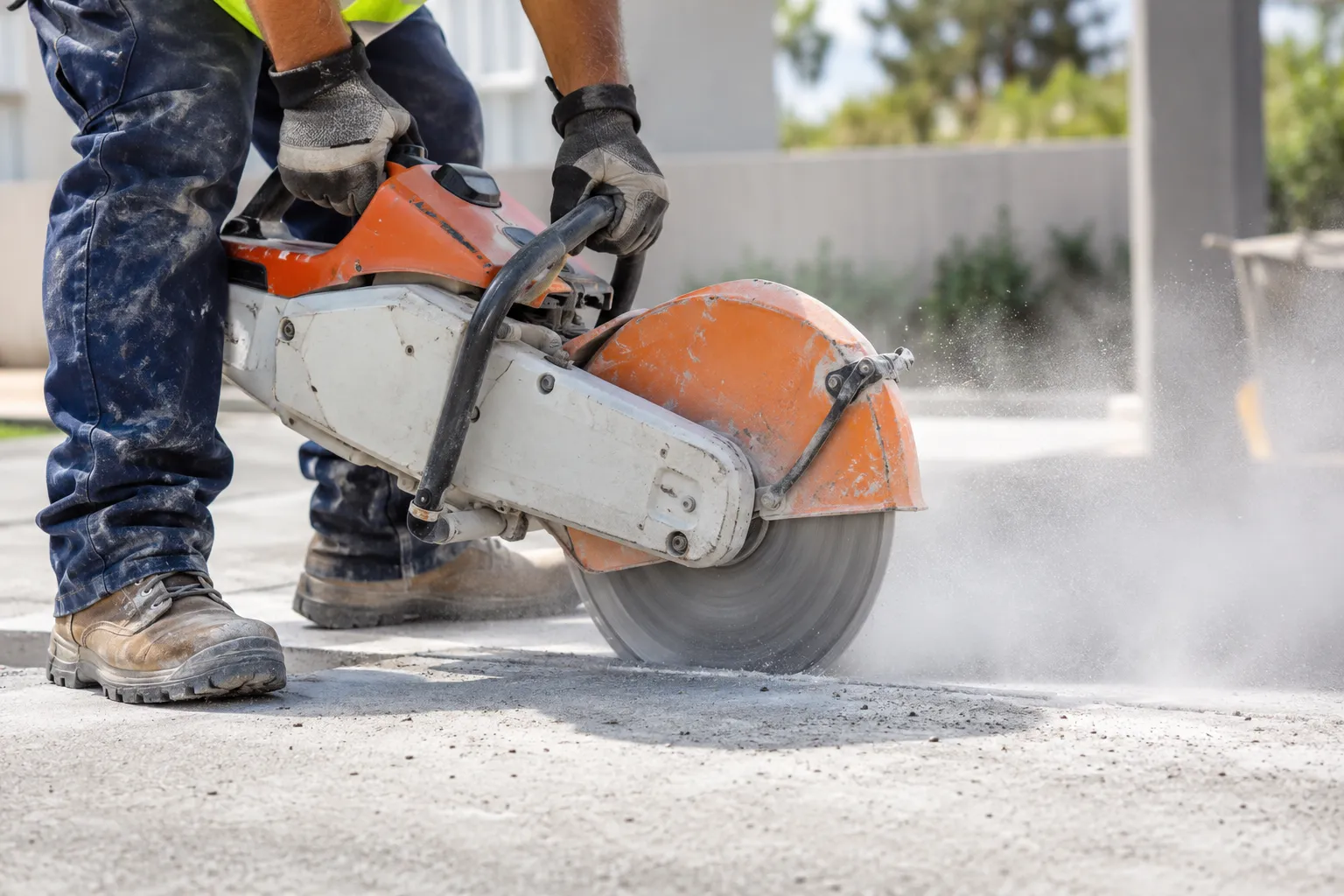
Is dry cutting concrete illegal? While it isn’t always unlawful in Australia, uncontrolled dry cutting concrete is. Since 1 September 2024, work health and safety laws require any cut into concrete, brick, stone, or tile to be controlled, so dust does not compromise respiratory function and long-term health.
If you’re about to hire a commercial concrete cutting company, this issue matters to you, not just the contractor. A crew that cuts dry with nothing to catch the dust puts its own workers, your staff, and anyone nearby at risk. It can also bring your project to a halt if a safety inspector orders work to stop.
At Cutrite, we provide safe concrete coring services, use innovative concrete scanning technology, and wear Personal Protective Equipment (PPE) to ensure your project keeps running smoothly and remains compliant with Australian law. This blog explores whether dry concrete is illegal in Australia, empowering you with knowledge to make informed decisions for your project.
Key Takeaways
- Dry cutting concrete is not automatically illegal across Australia, but uncontrolled dry cutting of silica-containing materials may breach workplace health and safety requirements, depending on the state or territory.
- Silica dust is a serious health hazard, as inhaling fine particles can cause silicosis, lung cancer and other permanent health problems.
- Wet cutting helps control airborne dust, using a continuous water supply to reduce silica particles released during concrete cutting.
- Dust extraction and respiratory protection may also be required, depending on the cutting method, material and exposure risks.
- Contractors must follow applicable WHS requirements, assess risks and implement effective controls before cutting concrete, prioritising worker and public safety.
Australian Concrete Cutting Rules Explained
The rules on concrete cutting in Australia focus on crystalline silica, a natural mineral found in sand, rock, and concrete. Under the country’s work, health, and safety laws, any material containing at least 1% crystalline silica must be cut in a controlled way. Concrete clears that bar easily.
In Queensland, for example, a cut only counts as controlled if the contractor uses at least one of these methods:
- Water to dampen the dust at the blade.
- A dust extraction system fitted to the saw.
- A local exhaust ventilation system.
- Keeping people physically away from the dust.
- A sealed operator cabin with a high-grade air filter.
If anyone is still at risk, they must wear suitable protection, such as a full-face respirator. The business must also assess the risk before work starts. Jobs judged high risk need a written safety plan and workers with approved silica training.
Remember, dry concrete cutting isn’t banned outright in Australia. Dry cutting a concrete slab can be legal if the saw has an effective dust extraction system attached. What’s illegal is firing up a saw with nothing capturing the dust, compromising the health of workers and staff on-site.
Queensland’s rules on processing silica took effect on 1 September 2024, and most other states adopted the same national model. Victoria and the ACT run their own silica rules, so check local requirements if your project crosses borders.
Silica Dust: The Controversial Issue
When a blade cuts concrete, it throws up silica dust fine enough to settle deep in the lungs. Over years, that can cause silicosis, an incurable scarring of the lungs, as well as lung cancer.
The numbers are sobering. Curtin University modelling estimated that more than half a million Australian workers are exposed to silica dust on the job. It predicted that over 10,000 will develop lung cancer and up to 103,000 will be diagnosed with silicosis as a result. The researchers named wet cutting during concrete work as one practical way to significantly reduce that risk.
Wet vs. Dry Concrete Cutting
Both methods can be legal when done properly. The right choice depends on your site, as shown in this wet vs dry concrete cutting table:
| Wet cutting | Dry cutting with dust extraction | |
| How dust is handled | Water traps dust at the blade. | An industrial vacuum sucks it up at the saw |
| Best suited for | Outdoor work, thick slabs, long or deep cuts | Indoor fit-outs, occupied buildings, |
| Main drawback | Leaves a wet slurry that must be contained | Vacuums and filters need constant checking |
| Clean-up | Slurry can’t go down stormwater drains | Collected dust must be bagged and disposed of safely |
Wet cutting is the usual choice for heavy commercial work. Dry cutting with good extraction earns its place where water would damage something or create a slip hazard. An experienced contractor will explain why they’ve chosen one method over the other for your job.
Questions to Ask Before Hiring a Contractor
The cutting company carries the main legal duty. But as the person in charge of the site, you can share some of the responsibility. These questions will quickly show whether a contractor takes dust seriously:
- How will you control dust? Will you use water, extraction, or both?
- Can I see your risk assessment and written safety plan?
- Have your operators completed approved silica training?
- Do your vacuums have filters designed for fine silica dust?
- How will you contain and dispose of slurry or collected dust?
If the answers are vague, keep looking. A cheap quote from a crew that cuts with no dust control can cost you far more in delays, fines, and harm to people.
At Cutrite, we offer safe, worry-free hand and ring sawing services in Brisbane that keep your project running smoothly. Our extensive track record across different industries and expert concrete cutters provide long-term peace of mind. Book an appointment today to experience innovative concrete cutting services that guarantee results.
Frequently Asked Questions (FAQs)
Is dry cutting concrete illegal in Queensland?
Uncontrolled dry cutting is illegal in the state. Queensland law requires dust to be controlled with water, on-tool extraction, ventilation, or isolation, plus respiratory protection where risk remains. Dry cutting with an effective extraction system can be lawful.
Does concrete really contain silica?
Concrete is made with sand and crushed rock, both rich in crystalline silica. It sits well above the 1% level that triggers Australia’s silica rules.
Is wearing a mask enough when dry cutting?
No. The law expects dust to be controlled at the saw first. A respirator is an extra layer of protection, and it only works if it fits properly.
What happens if a contractor cuts without dust control?
Safety inspectors can stop the work, issue notices and fines, and prosecute serious breaches. Your project may stall while the problem is fixed.
Is wet cutting always better than dry cutting?
Not always. Wet cutting suits outdoor and heavy-duty work, but water can damage electrics, finishes, and occupied spaces. For this reason, dry cutting with proper extraction is often the better option in these settings.