

Many large-scale commercial projects in Australia require concrete cutting to create precise openings, remove structural elements, and upgrade infrastructure. Regardless of your unique project requirements, clients must determine the appropriate concrete cutting technique to achieve optimal long-term outcomes.
Nowadays, wall sawing and floor sawing are the gold standard for cutting concrete in various commercial applications. Although both methods rely on innovative diamond blade technology, they have unique purposes. Choosing the wrong technique can lead to costly delays, rework, or compromising visual appeal and long-term structural integrity.
You can prevent these scenarios by taking proactive measures and smart, calculated risks for your project. As a reputable provider of Brisbane wall sawing services since 2003, we provide critical insights that help our clients enjoy smooth project timelines.
Key Takeaways
- Wall sawing is designed for vertical concrete surfaces, making it ideal for creating openings for doors, windows, HVAC systems, and structural modifications with precise cuts.
- Floor sawing focuses on horizontal surfaces, including concrete slabs, roads, pavements, and floors, using diamond blades for accurate cutting.
- Wall saws provide smooth, controlled finishes with minimal vibration, helping preserve surrounding structures during complex cutting projects.
- Floor sawing offers speed and efficiency for removing concrete, installing utilities, creating expansion joints, and completing large-scale construction tasks.
- Choosing the right method depends on the project requirements, including surface orientation, cutting depth, precision needs, and the type of concrete structure involved.
This blog delves deeper into the basics of wall sawing and floor sawing, helping you make informed decisions that lead to long-term peace of mind.
Exploring the Key Differences Between Floor Sawing and Wall Sawing
Floor sawing and wall sawing are specialised diamond concrete cutting techniques that serve distinct purposes. Knowing the differences between the two methods enables you to determine the best intervention for your commercial project in Australia.
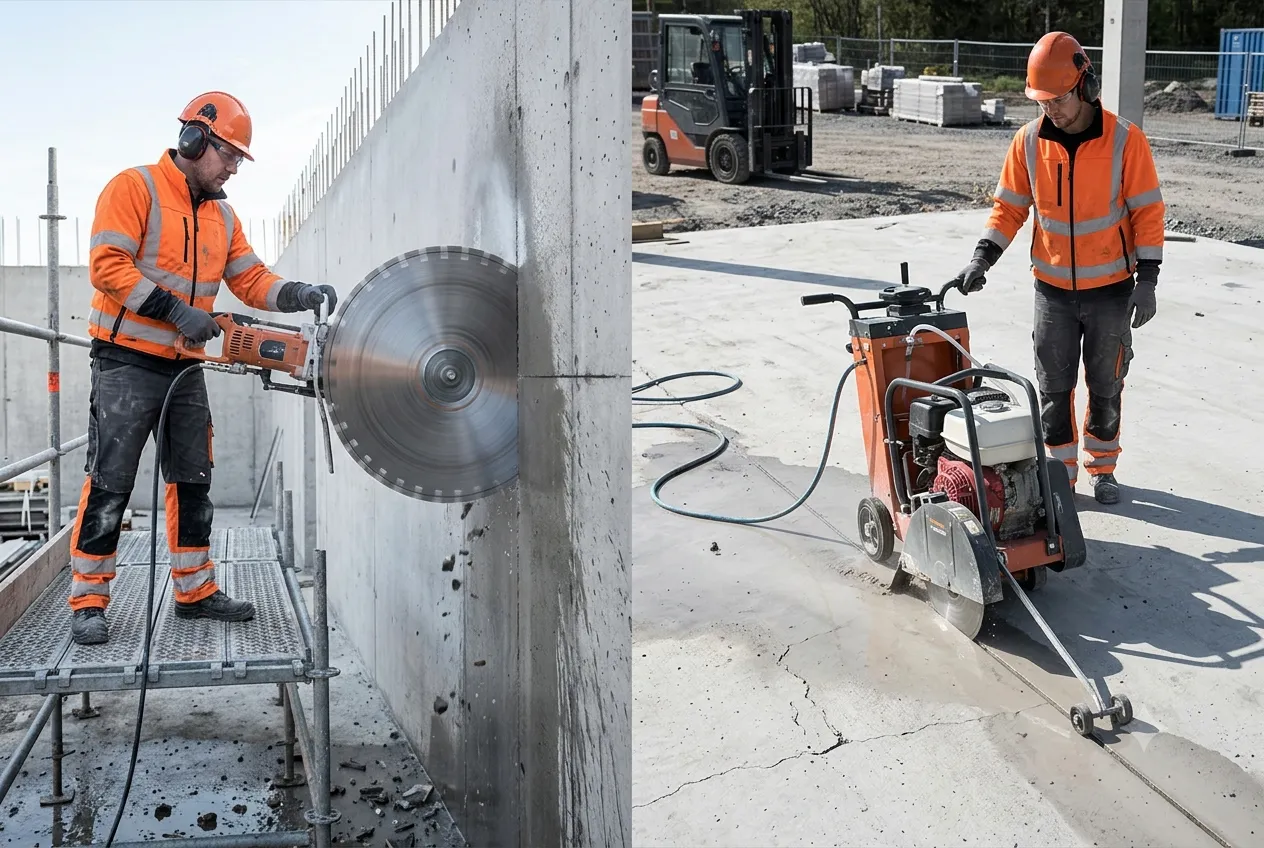
- Floor sawing: Also known as slab sawing, this concrete cutting method involves using a walk-behind saw with a diamond blade to cut horizontal concrete surfaces.
Providers of innovative Brisbane road sawing services typically employ this technique for concrete slabs, roads, highways, bridge decks, warehouse floors, expansion joints, and trenching for utilities. Contractors also use slab sawing methods for cutting trenches to access plumbing and electrical utilities underneath a concrete slab, removing damaged or obsolete flooring, and forming expansion joints in concrete pours to prevent cracking in the long run.
Floor sawing is a safe concrete cutting technique since it uses water as a coolant and as a dust suppressant, drastically reducing harmful silica dust exposure. This method also prevents adjacent slab vibration, preserving its long-term structural integrity.
- Wall sawing: Also known as track sawing, this concrete cutting technique uses a diamond blade mounted on a track system to make accurate cuts in vertical or inclined concrete structures.
Wall sawing is commonly used for door and window openings, lift shafts, stairwells, wall removals, structural alterations, and reinforced concrete walls.
Since the saw runs along a fixed track, technicians create accurate, flawless, and crack-free cuts that are drastically different from those of conventional impact-based demolition. As a reputable provider of Brisbane core drilling services for nearly 25 years, we recommend wall sawing for occupied commercial buildings where the surrounding structures must remain intact throughout the project.
It’s important to note that each method is designed for specific applications, depending on the material, cutting depth, and project requirements.
Maximum Cutting Depth: An Important Distinction
Maximum cutting depth is a helpful distinction between wall sawing and floor sawing. Understanding this aspect enables you to determine the best approach for your commercial project in Australia.
Wall sawing can cut up to depths of 1,8 m from both sides of a wall, per Cobra Concrete. For this reason, track sawing is an ideal concrete cutting strategy for prominent structural walls and footings.
On the other hand, floor saws can usually cut depths measuring 15 cm to 60 cm depending on the blade size, per Bison Machinery. This depth range is considerably different from that of wall sawing and is often used for conventional slab and pavement applications, including roads, highways, and bridge decks.
The depth required for your commercial project is a primary consideration in deciding between floor sawing and wall sawing. If you’re unsure about your options, consulting a highly experienced concrete cutting specialist in your area can help you make informed decisions. For more detail, read how concrete thickness affects cutting methods.
Why Choosing the Right Concrete Cutting Technique Matters for Your Project
Unfortunately, choosing the wrong concrete cutting technique can lead to unnecessary delays, steeper project costs, and site safety hazards.
The incorrect method can drastically affect the quality and accuracy of the cut, especially when working around reinforced concrete, post-tensioned slabs, or load-bearing structural elements. For this reason, accurate planning is essential to prevent long-term damage and preserve the adjacent structures. It’s critical to remember that floor saws were designed for horizontal surfaces. On the other hand, wall saws are engineered for vertical and inclined structures.
Reputable concrete cutting contractors always conduct a comprehensive site assessment, including cut orientation, cutting depth, reinforcement, and structural considerations before recommending the appropriate technique. Working with a reputable contractor ensures critical variables are addressed before your project begins, enabling you to comply with Australian workplace safety standards and experience smooth project timelines.
Conclusion
Wall sawing and floor sawing are efficient and innovative concrete cutting methods that are engineered for specific purposes. While floor sawing is the ideal solution for horizontal surfaces, such as concrete slabs, roads, highways, and bridge decks, wall sawing delivers the precision required for vertical structures, structural openings, and significant building alterations.
Determining the appropriate method can improve safety, reduce project delays, minimise project overruns, and deliver optimal, long-term outcomes. Investing in premium concrete cutting services ensures that your project uses the correct techniques and cutting depth to meet your unique structural requirements.
For nearly 25 years, Cutrite has provided cost-effective wall sawing, floor sawing, road sawing, and core drilling services in Australia. Whether you’re planning a commercial construction project or infrastructure upgrade, our highly experienced staff can deliver safe and accurate results that exceed your expectations. Book an appointment today to discuss your unique requirements and experience innovative concrete cutting solutions that bring commercial projects in Australia to life.